
Addams Family Values story
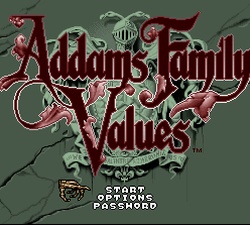
Addams Family Values has that rare ingredient that lets a licensed game outlive its license: personality. When Ocean Software picked up the sequel based on the fresh film Addams Family Values, the studio didn’t repeat its old jumpy platformer trick. They wanted to channel the family’s oddball vibe differently: not by hopping through attics, but by strolling a strange, top-down world in the mold of a sturdy SNES action-adventure. So Uncle Fester took center stage, while a UK team that knew how to turn movie hits into playable legends worked behind the curtain. The cartridge neatly packs in the gothic humor, the shivery mansion atmosphere, and a string of bite-size tasks that all point to one thing—rescuing baby Pubert from Debbie Jellinsky, grinning at the irony in every line.
From idea to cartridge
Ocean had their finger on the pulse: their The Addams Family had already found a home on Super Nintendo, and the second film nudged them toward a different lens. Less running, more exploring—rooms, gardens, and dungeons where every door is a puzzle and every quip is a jab. The top-down format wasn’t random: it let the world feel cohesive, with crisscrossing paths, questy details, and the vibe of a “grown-up” fairy tale. In what many casually called “Addams Family 2,” the devs leaned into a Zelda-like structure: collect keys, find routes, tackle boss fights, chat with snarky NPCs, and slowly tease apart the knot.
The game’s fabric is stitched from the family’s eccentricity and Gomez’s sly wisdom, woven into events. Encounters with relatives, a parade of peculiar neighbors, and “accidental” errands blend into a smooth adventure where quest bits grow organically from the setting. Expect secret rooms, side jobs, and the little delights of an Easter-egg hunter. All of it rides on that signature gothic chuckle that somehow makes the dark feel cozy.
Out in the world
Europe saw the carts in 1994, the States a little later, and on both sides of the Atlantic it shipped under the familiar poster—Addams Family Values; locally, people often stuck with “Family Values.” There wasn’t much marketing drumroll, and maybe that’s for the best—Fester’s story isn’t about hype, it’s that candlelit-at-home feeling when you grab a pad and wander through locations. Quietly, without pomp, the game filtered into collections, rental shelves, and later ROM folders, outlasting its theatrical window as a solid SNES adventure folks revisit for the mood rather than for new tricks.
Funny how it settled differently around the globe. Western reviews often called it surprisingly “smart” for a license, while elsewhere the down-to-earth “Addams Family: Family Values” stuck—no ceremony, just right. Retro forums saw both “Addams Family 2” and “Addams Family Values,” but everyone meant the same thing: a game that hits the nerve when you crave unhurried exploration and a slightly snarky fairy tale. That’s what happens with things that have a voice. You don’t debate them—you remember them.
Why it stuck
The recipe works in the details. A soundtrack whose organ flourishes tickle nostalgia in the best way. Dialogues that feel straight out of the Addams playbook—no meanness, just laser-aimed irony. Dungeons and garden paths that open as you find the right item or ability. The top-down view makes it inviting and clear: not a sprint, a stroll. Even the boss fights lean more on smarts than brute strength, leaving a warm aftertaste—like movie set pieces where action always serves character.
More important is how it handles the license. It doesn’t parrot the film beat for beat; it catches the rhythm. Debbie stays a looming shadow, Pubert the goal, and Fester your guide through a gallery of oddities. Ocean Software—long adept with film tie-ins—delivered not just “a movie game,” but a self-contained action-adventure. When you realize you’re not chasing credits so much as itching to peek down one more corridor, you know they hit the vein.
How it traveled
Fifteen years ago, other system versions popped up more in local chatter, but the SNES release earned quiet fame at retro nights and in classic compilations. Those who saw the cartridge on a 90s shelf remember the cover and the rustle of the box; those who came later found it in emulators and rediscovered the loop: explore — key — new area. Hand-drawn maps circulated, along with stories of someone finding another secret “where it looked empty.” Not a loud, textbook tale—just everyday love, with the name said like at home: sometimes “Family Values,” sometimes “Addams Family Values,” the intonation is what matters.
Today, people talk about it without nitpicking. That horizontal exploration flow—familiar from 16-bit greats—clicks here too: clusters of quests, whisper-thin hints, NPCs that paint context instead of dumping instructions. That’s why it keeps going—passed along in friend recs, in cozy “let’s roam the mansion” evenings, in personal fall shortlists. And if you want to break down how the combat feels and why the controls sing in this SNES classic—that’s the kind of nuts-and-bolts we unpack in our /gameplay/.